The Execution of Scotland's Guardian
On 23 August 1305, William Wallace was put to death at Smithfield, London. The Guardian of Scotland, who had led resistance against English occupation, was executed for high treason. His punishment was hanged, drawn, and quartered; a brutal medieval sentence designed to demonstrate the consequences of rebellion against the Crown.
According to contemporary accounts, Wallace was dragged through the streets of London before being hanged. While still alive, he was emasculated and eviscerated, his bowels burned before him. He was then beheaded and his body cut into four parts.
The Distribution of the Martyr's Body
The quartering of Wallace was not merely punishment; it was political theatre. Edward I ordered that his remains be displayed across the realm as a warning to dissenters. Historical sources agree that Wallace's head was placed on London Bridge. The disposition of his limbs, however, is recorded differently depending on the source.
The BBC History account and the Oxford Dictionary of National Biography state that Wallace's limbs were displayed at Newcastle, Berwick, Stirling, and Perth. These were strategically chosen locations representing the northern and eastern borders of Scotland.
Aberdeen's Claim
Local tradition in Aberdeen tells a different story. According to this account, documented in the Clan McAlister archive and referenced on St Machar's Cathedral's own Wikipedia entry, Wallace's left quarter was sent not to Perth but to Aberdeen. The claim states that this portion of his body was buried within the walls of St Machar's Cathedral in Old Aberdeen.
St Machar's Cathedral, technically the Cathedral Church of St Machar, is a Category A listed building and one of Scotland's most important medieval churches. The current structure dates from the 12th to 16th centuries. Its famous 48-panel heraldic ceiling was installed in 1520. The cathedral, though no longer an active cathedral since 1690, remains a significant historical monument.
A Tradition in Stone
Whether or not Wallace's remains rest within its walls, St Machar's Cathedral has become associated with his memory. The cathedral stands in Old Aberdeen, the historic quarter of the city that contains the University of Aberdeen's King's College and preserves a medieval street layout largely unchanged since the 14th century.
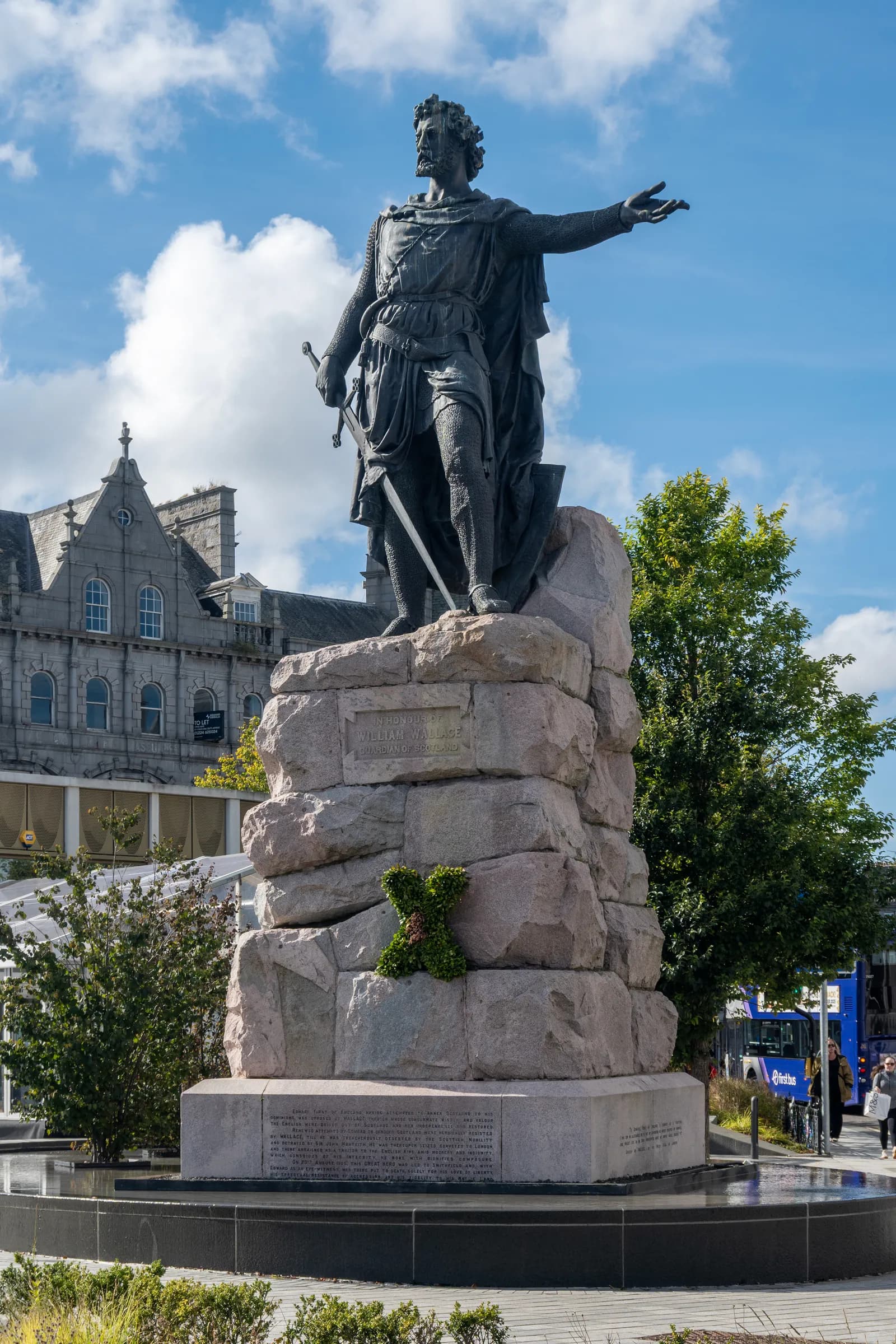
Aberdeen's connection to Wallace is also commemorated above ground. A statue of the Guardian stands on Union Terrace, opposite His Majesty's Theatre. Erected in 1888 and sculpted by William Grant Stevenson, the Category B listed monument bears inscriptions from Wallace's trial speech. The statue serves as a more visible, and less disputed, monument to the city's claimed association with Scotland's most famous resistance leader.
What History Records, What Tradition Remembers
The discrepancy between sources raises questions about how history is constructed. The major academic and encyclopaedic sources do not mention Aberdeen in their accounts of Wallace's execution. Yet the claim persists in local tradition and is repeated in Aberdeen-focused documentation.
Whether the left quarter of William Wallace lies within the walls of St Machar's Cathedral cannot be definitively proven or disproven from available records. The cathedral itself offers no public marker or memorial acknowledging the claim. What remains is a story passed through generations, connecting one of Scotland's most important medieval buildings to its most famous resistance leader.
The Forgotten Quarter
The title "Forgotten Quarter" carries multiple meanings. It refers, perhaps, to the physical quarter of Wallace's body said to be hidden in Aberdeen rather than displayed in Perth. It may also speak to Old Aberdeen itself; a historic quarter sometimes overlooked in favour of Edinburgh's Royal Mile or Stirling's battlefields.
Visitors to St Machar's Cathedral walk through a building that has stood for nearly a millennium. They pass beneath the heraldic ceiling, wander the medieval nave, and perhaps consider what might lie within the ancient walls. Whether history or legend, the connection between Wallace and the cathedral endures as part of Aberdeen's heritage.